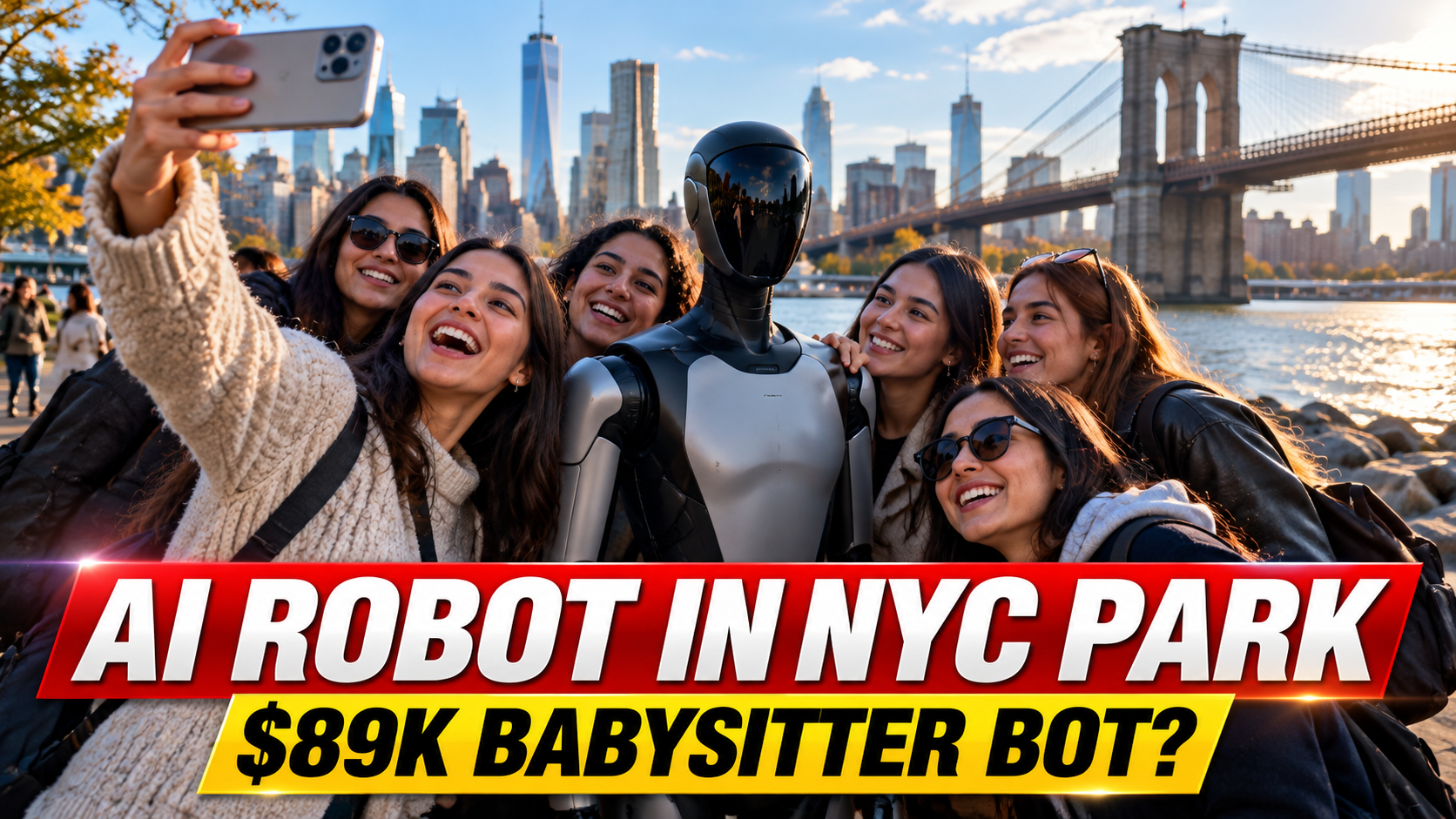
New Yorkers encountered an unusual visitor at Brooklyn Bridge Park this weekend: a nearly $90,000 humanoid robot moving among families, tourists and children as its developers explored how machines could eventually interact more naturally with people.
A humanoid robot developed by California-based Faraday Future drew attention in New York City after appearing in Brooklyn Bridge Park and interacting with members of the public.
The machine was accompanied by Faraday Future Chief Technology Officer Hong Rao, who was operating it during the demonstration.
Rather than being confined to a laboratory or factory floor, the robot was placed in a busy public environment where it could encounter ordinary social situations.
A robot built for more than industrial work
Faraday Future has been expanding beyond its electric-vehicle business into what it describes as embodied artificial intelligence.
One of its flagship humanoid platforms, the All-New Futurist, has been promoted for potential uses ranging from education and customer service to household assistance, healthcare support and companionship.
The company has announced a price of $89,900 for the full-size robot, including a software and skills package.
That puts the machine far beyond the price of a typical consumer device, but it also reflects the increasingly competitive race among technology companies to bring general-purpose humanoid robots into real-world environments.
Why put a humanoid robot in a public park?
The New York appearance offered something a controlled demonstration cannot easily reproduce: spontaneous interaction with people.
Visitors approached the robot, took photographs and watched as it moved through the park.
According to comments made during the demonstration, Faraday Future is interested in developing machines that can better understand how people behave and communicate.
The long-term vision could eventually include robots performing more personal roles, such as assisting families, teaching, providing companionship or helping with everyday tasks.
Those possibilities remain largely developmental rather than established consumer services.
Could robots really become caregivers?
Humanoid robots are increasingly being designed to operate in environments built for humans.
Their shape allows them, at least in theory, to navigate homes, offices, schools and other places without requiring those environments to be completely redesigned.
But allowing an AI-powered machine to supervise children or vulnerable people would raise major questions involving safety, reliability, privacy and responsibility.
For now, demonstrations such as the one in Brooklyn are better viewed as experiments in human-robot interaction rather than proof that robotic babysitters are ready to enter American homes.
Faraday Future is making a major robotics push
The company has accelerated its robotics strategy throughout 2026.
Faraday Future recently announced additional humanoid products and developer programs while pursuing a broader restructuring of its robotics business.
Its portfolio now ranges from relatively inexpensive educational robots to sophisticated full-size humanoid machines costing tens of thousands of dollars.
The move places Faraday Future in a rapidly developing market where companies are competing to determine whether humanoid robots can move from technology demonstrations into everyday commercial use.
A glimpse of a very different future
Seeing a humanoid robot surrounded by tourists in a New York park may still feel unusual today.
But the demonstration highlights a broader shift taking place across the technology industry.
Artificial intelligence is increasingly moving beyond screens and software into machines capable of walking, observing and physically interacting with the world around them.
Whether robots like Faraday Future's ultimately become teachers, household assistants, companions or simply highly specialized machines remains uncertain.
What is becoming clearer is that the race to put humanoid robots into everyday human environments has already begun.