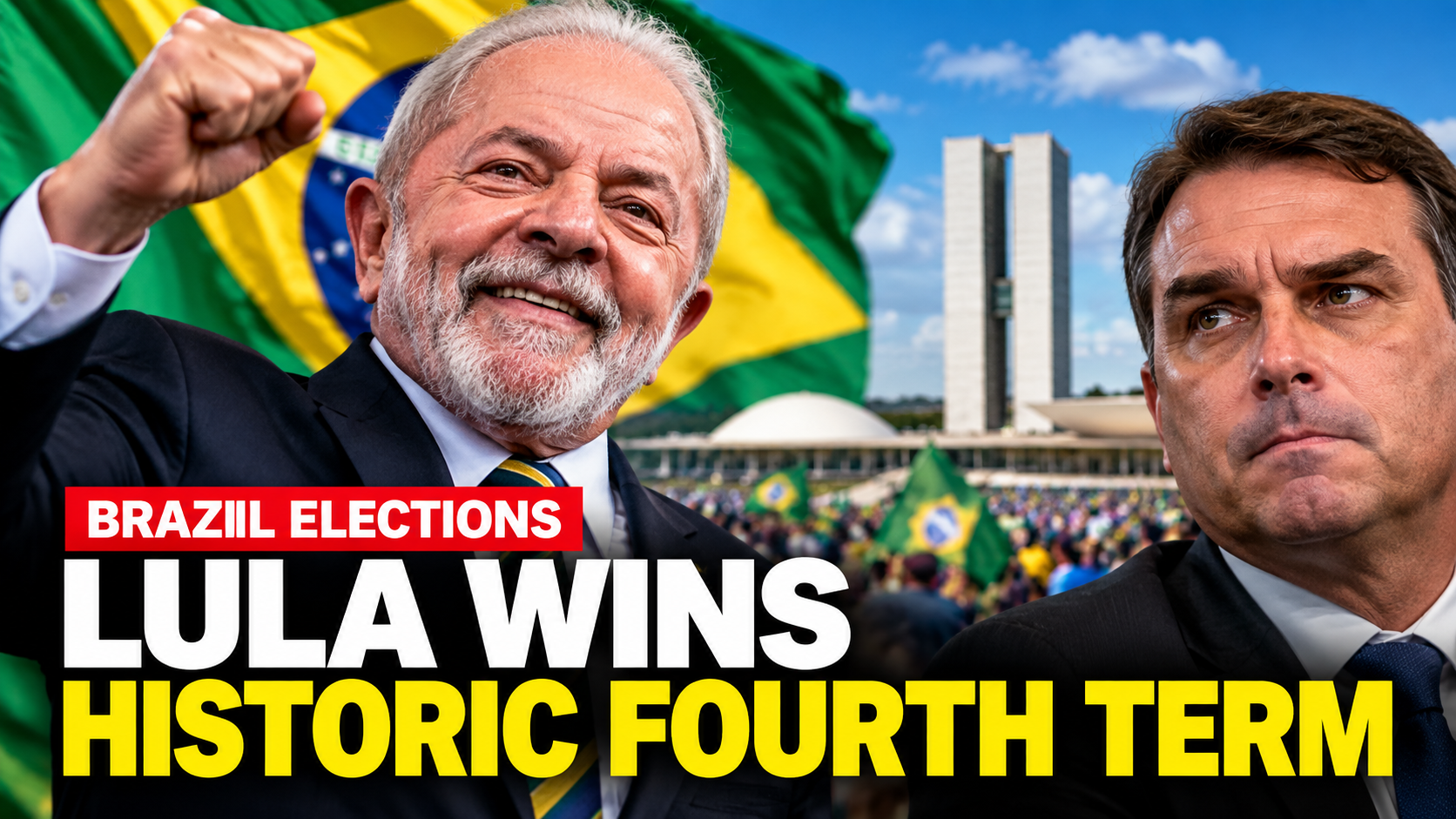
Brazil has entered a new political chapter after Luiz Inácio Lula da Silva secured a historic fourth presidential term, defeating Senator Flávio Bolsonaro in a tightly contested runoff that has already triggered political and financial uncertainty.
Brazil’s Superior Electoral Court confirmed early Monday that Lula won reelection with 64,256,232 votes, or 51.79% of the valid vote.
Flávio Bolsonaro received 59,826,041 votes, or 48.21%, leaving a gap of more than 4.4 million votes between the two candidates.
Bolsonaro refuses to concede
The result quickly became more contentious after Flávio Bolsonaro said he would not recognize Lula’s victory and signaled plans to seek the annulment of the runoff.
Bolsonaro criticized a decision that extended voting hours by two hours in parts of the country and argued that the change created questions about the legitimacy of the process.
At this stage, however, no successful legal challenge has overturned the result, and Brazil’s electoral authorities have formally announced Lula as the winner.
The dispute could now move into the courts, while authorities and political leaders watch closely for possible demonstrations.
Brazil’s election authorities confirm the result
The Superior Electoral Court said more than 128 million Brazilians participated in the second round, with voter abstention at approximately 19.2%.
Election officials also reported that only a small fraction of the nearly 500,000 voting machines used nationwide required replacement.
The TSE described the second round as successfully completed despite logistical and legal challenges during the voting and counting process.
Lula calls for unity
Following the result, Lula adopted a conciliatory tone and said his government would represent all Brazilians, including those who did not vote for him.
His victory comes after a deeply polarized campaign centered on economic policy, social programs, public debt, crime, institutional trust and Brazil’s relationship with the United States.
Lula campaigned heavily on reducing poverty and inequality while defending social programs and environmental protections.
Markets react sharply
Brazil’s political uncertainty quickly spilled into financial markets.
Investors had been closely watching the election because of concerns surrounding fiscal policy, government spending, interest rates and Brazil’s already elevated public debt.
The Brazilian real could also face renewed pressure as markets assess how Lula plans to manage the economy during another term.
A difficult Congress awaits
Winning the presidency does not guarantee Lula an easy path.
The new Congress includes a strong bloc of lawmakers aligned with Bolsonaro and other conservative parties.
That could make it difficult for Lula to advance major spending plans or structural reforms without significant negotiation.
Brazil also faces economic challenges including high interest rates, household debt and public debt exceeding 80% of gross domestic product.
The Bolsonaro challenge could shape the next phase
Flávio Bolsonaro’s refusal to concede adds another layer of uncertainty to Brazil’s transition.
His father, former President Jair Bolsonaro, had previously challenged Brazil’s electoral system following the 2022 election, making the current dispute especially sensitive for the country’s democratic institutions.
So far, Flávio Bolsonaro has said he intends to pursue legal avenues rather than accept the result.
Whether that challenge gains meaningful legal support remains uncertain.
Brazil enters a new political chapter
Lula’s victory represents both continuity and another major comeback for one of Latin America’s most recognizable political figures.
But the election also leaves Brazil sharply divided.
The official result is clear: Lula won the runoff with 51.79% of the valid vote. What happens next will depend on how Bolsonaro’s challenge develops, how Brazil’s institutions respond and whether the incoming government can govern effectively with a highly divided Congress.